Automated gates have become increasingly popular among Auckland homeowners looking to enhance security, convenience and property value. An automated gate allows you to open and close your driveway gate at the touch of a button, without leaving your car or home. Whether you are upgrading an existing manual gate or installing a brand new entrance, understanding the process, costs and requirements is essential.
This comprehensive guide covers everything Auckland homeowners need to know about automated gate installation, from choosing the right system to understanding council requirements and ongoing maintenance.
Why Install an Automated Gate?
Before diving into the technical details, it is worth understanding why automated gates have become so popular in Auckland. The benefits go far beyond simple convenience.
Security is the primary reason most homeowners choose automated gates. A properly installed automated gate creates a physical barrier that deters opportunistic crime, prevents unauthorised vehicle access and makes it harder for intruders to target your home. In Auckland suburbs where burglary remains a concern, an automated gate adds a significant layer of protection.
Convenience is another major factor. With an automated system, you can open your gate using a remote control, smartphone app, keypad or intercom without having to get out of your car. This is particularly valuable during Auckland's wet winter months when manually opening a gate means getting soaked.
Property value is also worth considering. A well-designed automated gate enhances street appeal and can increase your property's value by creating a premium impression. Real estate agents across Auckland consistently note that properties with automated gates tend to attract more interest from buyers who value security and convenience.
Finally, automated gates offer improved safety for families with children or pets. The gate remains closed at all times unless actively opened, preventing children from wandering onto the road and keeping pets safely within the property.
Types of Automated Gate Systems
There are two main types of automated gates, each suited to different property layouts and budgets.
Sliding gate automation systems use a motor to drive the gate along a track or cantilever mechanism. The motor is typically mounted at the opening point and engages a rack attached to the gate. Sliding gates are ideal for properties with limited space, steep driveways or where a swing gate would obstruct footpaths or neighbouring properties.
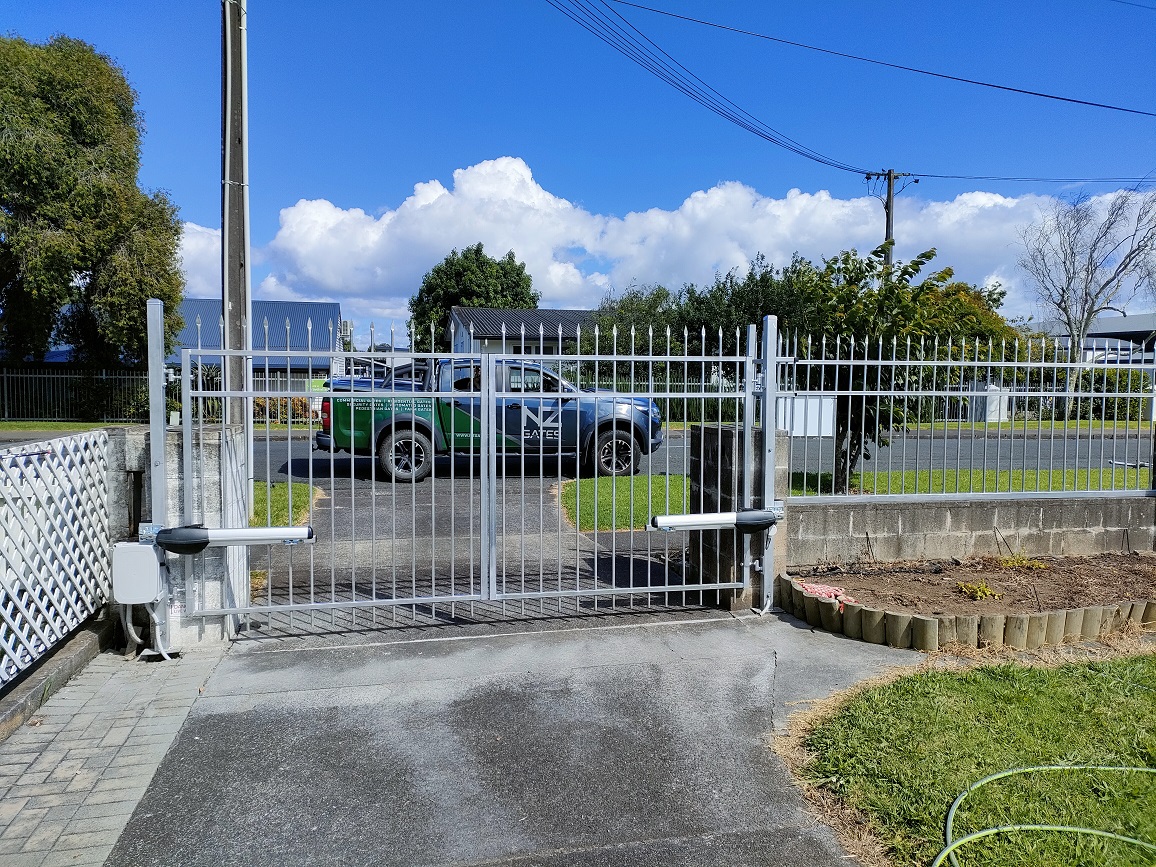
Swing gate automation uses articulated arm actuators or underground motors to push the gate open and closed. Each leaf of a double swing gate has its own motor. Swing gate automation is generally quieter and more visually discreet than sliding systems, making it popular for residential properties where aesthetics matter.
Within these two categories, there are further options to consider:
Hydraulic motors offer superior power and durability, making them ideal for heavy gates or high-traffic commercial properties. They are more expensive but provide smoother operation and longer service life.
Electromechanical motors are more common in residential settings. They are cost-effective, reliable and easier to service. Most standard Auckland residential gates use electromechanical motors.
Solar-powered automation is an excellent option for properties without easy access to mains power. A solar panel charges a battery that runs the motor, eliminating the need for trenching and electrical work. This is particularly useful for rural properties on the outskirts of Auckland.
Choosing the Right Motor for Your Gate
Selecting the right motor is critical to ensuring reliable, long-term performance. The motor must be powerful enough to handle the weight and length of your gate, with some capacity to spare for wind resistance and wear over time.
Gate weight is the primary consideration. A lightweight aluminium gate may only need a motor rated for 300kg, while a solid steel gate could require a motor rated for 600kg or more. Always choose a motor with a higher capacity than your gate weight to ensure smooth operation and longevity.
Gate length also matters. Longer gates create more leverage on the motor, particularly in windy conditions. Auckland can experience strong winds, especially in coastal areas, so wind load should be factored into motor selection.
Duty cycle refers to how frequently the gate can be operated within a given period. Residential gates typically have a duty cycle of 30-50 operations per hour, which is more than sufficient for most homes. Commercial properties may need higher duty cycles.
Access Control Options
One of the biggest advantages of automated gates is the range of access control options available. You can mix and match different methods to suit your household and visitors.
Remote controls are the most common access method. Each remote can be programmed to open the gate, and you can have multiple remotes for different family members. Rolling code technology ensures that codes cannot be copied or intercepted.
Keypads provide an alternative for households where remotes may be lost or forgotten. A PIN code allows entry without a remote, which is useful for tradespeople, cleaners or gardeners who need regular access.
Intercom systems allow visitors to call the house from the gate. Audio-only intercoms are budget-friendly, while video intercoms let you see who is at the gate before opening it. Many modern systems integrate with smartphones, allowing you to answer the intercom and open the gate from anywhere in the world.
Loop detectors are installed in the driveway and detect the presence of metal objects (vehicles). They are commonly used to automatically open the gate when a resident's car approaches, or to keep the gate open while a vehicle is passing through.
Timer-based access can be configured to automatically open or close the gate at specific times. For example, the gate could automatically close at 8pm each evening or open during business hours for a commercial property.
Council Requirements and Building Consents in Auckland
One of the most common questions Auckland homeowners ask is whether they need council consent for an automated gate. The answer depends on several factors.
Under Auckland Council rules, most residential gates under 2 metres in height do not require building consent. However, there are important exceptions and conditions to be aware of.
If your gate crosses a public footpath, you may need council approval for the crossing area. The gate must not obstruct pedestrian access when open, and you may need to maintain a minimum clearance from the footpath edge.
Electrical work for the gate motor must be carried out by a licensed electrician and certified under New Zealand electrical safety regulations. This includes running power to the gate, installing the motor and connecting safety devices.
If your property is in a heritage zone or has special character overlay, there may be restrictions on gate design, materials and colour. Check with Auckland Council's planning department before proceeding.
For commercial properties, additional requirements may apply, including compliance with the Health and Safety at Work Act for automated machinery. Commercial gates must have documented safety assessments and regular maintenance records.
Safety Features Every Automated Gate Needs
Safety is paramount when installing an automated gate. A gate that can exert enough force to move a heavy panel can also cause serious injury if it encounters a person, vehicle or object.
Photoelectric sensors are the most common safety device. These are installed in pairs on either side of the gate opening and create an invisible beam. If the beam is broken, the gate stops and reverses. Most systems require at least two pairs, one at knee height and one at vehicle height.
Edge sensors are pressure-sensitive strips attached to the leading edge of the gate. If the gate contacts anything, the sensor triggers an immediate stop and reversal. Edge sensors are particularly important for sliding gates.
Force limitation is a built-in feature of modern gate motors. The motor is calibrated to detect resistance and stop if it encounters an obstacle. This should be tested regularly as part of maintenance.
Warning signs are required by New Zealand standards on all automated gates. Signs should indicate that the gate is automated and warn of the risk of crushing or entrapment.
Manual release is a critical feature that allows the gate to be opened by hand in the event of a power outage or motor failure. Every automated gate should have a manual release key or lever that is easily accessible.
Installation Process
The installation process for an automated gate typically follows these steps:
First, a site assessment is conducted to measure the opening, check ground conditions, assess power availability and identify any potential obstructions or safety concerns.
Next, the gate is fabricated or sourced. If you are having a custom gate made, this can take 2-4 weeks. Off-the-shelf gates may be available sooner.
The gate posts are then installed. This involves digging foundations, concreting the posts and allowing the concrete to cure. Post foundations must be deep enough to support the gate weight and resist wind loads.
Once the posts are set, the gate is hung and adjusted. For sliding gates, the track is installed and levelled before the gate is placed. For swing gates, the hinges are attached and the gate is aligned.
The motor is then installed and connected to power. Electrical work must be performed by a licensed electrician. The motor is wired to the control board, safety sensors and access control devices.
Finally, the system is tested and commissioned. This includes testing safety sensors, calibrating motor force, programming remotes and ensuring the gate operates smoothly in both directions.
Costs of Automated Gate Installation in Auckland
The cost of an automated gate installation varies widely depending on the gate type, materials, motor system and access control features.
A basic automated sliding gate with a standard motor and two remotes typically starts at around $4,000 to $6,000 for the gate and motor, plus installation costs of $1,500 to $2,500.
Mid-range systems with a custom-designed gate, quality motor, intercom and safety sensors generally range from $7,000 to $12,000 fully installed.
High-end systems with premium materials, video intercom, smartphone integration and solar power can range from $12,000 to $20,000 or more.
Ongoing costs include electricity (minimal for most systems), annual maintenance ($150-$300) and occasional replacement of remotes or batteries.
Maintenance and Troubleshooting
Regular maintenance is essential to keep your automated gate operating safely and reliably. Auckland's coastal climate can accelerate corrosion, so gates in coastal areas need more frequent attention.
Recommended maintenance includes monthly visual inspections of the gate, posts and motor for signs of damage or corrosion. Clean the gate track or hinges and remove any debris that could obstruct operation.
Every six months, test the safety sensors by placing an object in the gate path and confirming that the gate stops and reverses. Check the manual release mechanism to ensure it operates smoothly.
Annually, have a qualified technician service the motor, lubricate moving parts, check electrical connections and recalibrate the force settings. This is also a good time to replace remote batteries and update access codes.
Common issues include gates that stop mid-operation (often caused by debris on the track or sensor obstruction), remotes that stop working (usually battery-related) and motors that strain or make unusual noises (indicating wear or misalignment).
If your gate is not operating correctly, it is important to have it inspected promptly. Continuing to use a malfunctioning automated gate can create safety hazards and cause further damage to the system.
Choosing the Right Installer
Selecting the right gate installer is as important as choosing the right gate. Look for a company with proven experience in automated gate installation, proper licensing and a solid warranty.
Ask about their experience with similar properties, check references and ensure they provide a written warranty covering both the gate and the automation system. A reputable installer will also handle safety certification and provide documentation for your records.
At NZ Gates, we have over 30 years of experience designing, fabricating and installing gates across Auckland. Our automated gate systems are built to last, with quality motors, comprehensive safety features and professional installation backed by warranty.