For industrial facilities, manufacturing plants, freight terminals, and distribution centres across Auckland, entry gates serve a far more demanding purpose than standard commercial or residential barriers. Industrial gates in Auckland must withstand round-the-clock traffic, heavy articulated truck movements, harsh environmental exposure, and persistent security risks including ram-raids and unauthorised yard intrusion.
Whether you operate a warehouse hub in Highbrook or East Tamaki, a manufacturing depot in Penrose or Mount Wellington, or a transport terminal in Wiri or Airport Oaks, securing your perimeter with an engineered industrial gate is vital for safeguarding assets, protecting personnel, and maintaining smooth operational logistics.
This comprehensive guide covers everything Auckland facility managers, operations directors, and property developers need to know about specifying, installing, automating, and maintaining heavy-duty industrial gates.
Why Industrial Gates Demand an Engineered Approach
Unlike commercial offices with predictable 9-to-5 vehicle flows, industrial sites face operational conditions that will rapidly wear out or destroy standard gate equipment.
Heavy vehicle loading is the most obvious challenge. Auckland logistics facilities process hundreds of heavy commercial vehicles every day, including B-train trucks, container sidelifters, flatbeds, and concrete mixers. When vehicles of this scale enter and exit, gates must provide wide clear spans, clear sightlines, and robust guidance mechanisms that cannot be easily derailed by road vibration or debris.
Operational frequency is another critical distinction. An industrial distribution centre gate may cycle 200 to 600 times per day, running 24 hours a day, 7 days a week. Standard commercial gate operators will overheat and burn out under this duty cycle. Industrial applications require continuous-rated power units designed for non-stop cycles.
Perimeter security and asset protection in New Zealand industrial estates have also taken on heightened urgency. High-value equipment, copper, tools, and bulk stock stored in external yards make industrial compounds primary targets for opportunistic theft and organised ram-raids. An industrial security gate must present an insurmountable physical deterrent.
Finally, Auckland's unique climate creates severe atmospheric corrosion. With the Manukau and Waitematā harbours framing our main industrial corridors, industrial gates in suburbs like Airport Oaks, Onehunga, Rosebank Road, and Silverdale are continuously exposed to airborne salt and maritime humidity, combined with industrial particulate matter. Without certified hot-dip galvanising and heavy-duty protective finishes, gate frames deteriorate prematurely.
Primary Types of Industrial Gates for Auckland Facilities
Selecting the correct mechanical configuration is the foundation of any industrial perimeter installation. Each style provides distinct operational benefits depending on site topography, available runback space, and vehicle traffic velocity.
Heavy-Duty Tracked Industrial Sliding Gates
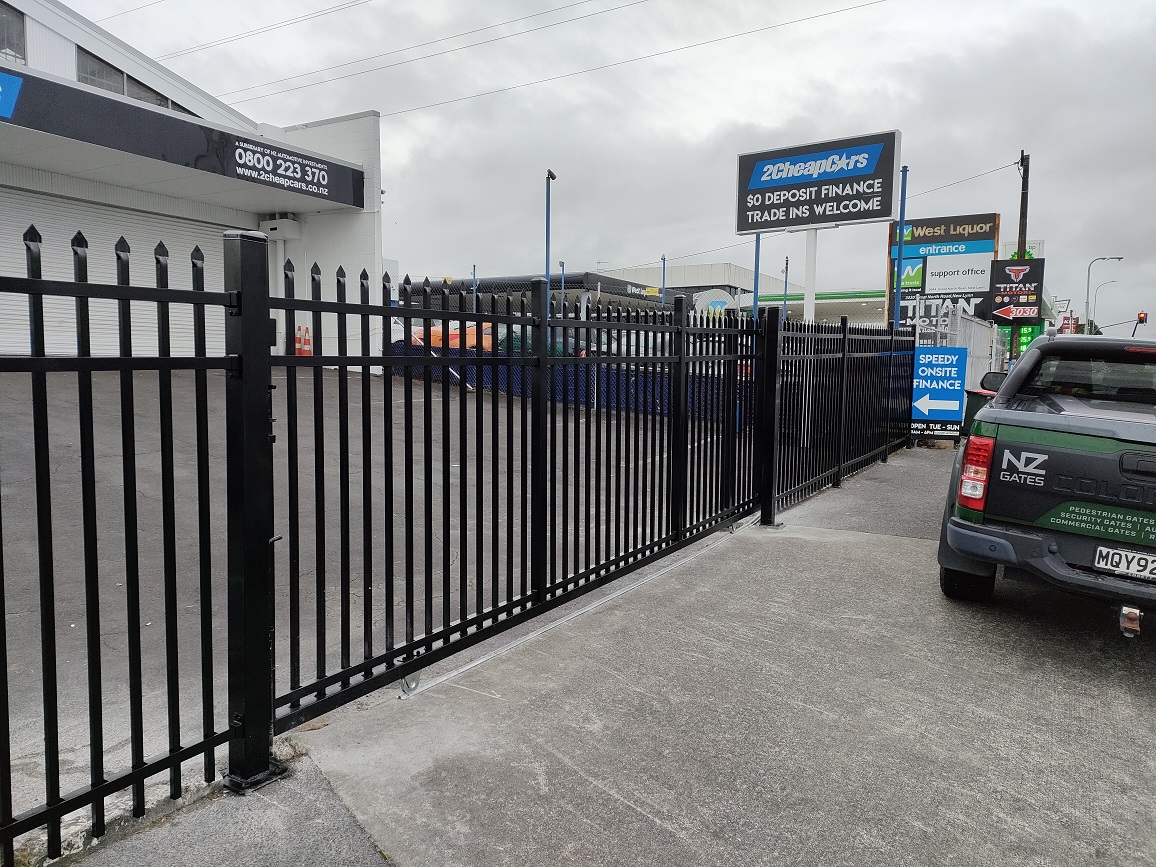
Tracked sliding gates are the industry standard for wide industrial entrances where level ground and sufficient runback space exist along the boundary fence line.
- Wide span capability: Engineered steel sliding gates can span clear drive openings from 8 metres up to 20 metres or more with a single leaf, or up to 30 metres with bi-parting double leaves.
- Exceptional lateral strength: Because the gate panel rests directly on hardened steel ground tracks supported by continuous reinforced concrete foundations, tracked sliding gates resist high wind loads and lateral impact forces.
- Space-efficient footprint: Sliding parallel to the boundary wall or security fence eliminates driveway encroachment, leaving the entire turning apron clear for heavy trucks and forklifts.
- Ideal applications: Container yards, logistics hubs, transport depots, building supply yards, and bulk storage facilities with level, well-drained concrete aprons.
Industrial Cantilever Sliding Gates
Cantilever gates are rapidly becoming the preferred industrial gate solution across Auckland due to their exceptional reliability in harsh working environments.
Unlike tracked gates, a cantilever gate is suspended entirely above the roadway. It is counterbalanced by an extended tail section that glides within internal roller carriage assemblies anchored to a massive concrete foundation block behind the entrance line.
- No ground track required: With no track laid across the roadway, cantilever gates eliminate issues caused by gravel, loose aggregate, mud, swarf, road subsidence, or heavy machinery rolling across sensitive track steel.
- Unaffected by road gradient or uneven surfaces: If the driveway slopes, undulates, or experiences ground settlement, a cantilever gate glides smoothly above the driveway surface without catching or binding.
- Minimal disruption during installation: Excavation is confined to the foundation pad off to the side of the entrance, avoiding the need to cut and repave the operational roadway.
- Ideal applications: Metal recycling facilities, quarries, concrete batching plants, timber processing yards, and facilities with unsealed or gravel access roads.
High-Speed Industrial Bi-Folding Speed Gates
When rapid vehicle turnaround and perimeter security cannot be compromised, tracked or trackless bi-folding speed gates deliver high performance.
Folding gates feature folding panels that fold back swiftly against the gate posts, achieving opening speeds up to one metre per second.
- Anti-tailgating protection: Rapid opening and closing times dramatically reduce the open window between vehicle movements, preventing unauthorised follow-through or pedestrian intrusion.
- Compact opening envelope: Bi-fold gates require only a fraction of the swing radius needed by traditional swing gates and zero lateral runback space, making them ideal for space-constrained urban industrial sites.
- Fast traffic clearing: High-throughput freight terminals eliminate entry queueing onto public Auckland arterials during peak logistics windows.
- Ideal applications: Courier distribution hubs, multi-tenant industrial business parks, secure car storage facilities, and high-security utility substations.
Heavy-Duty Industrial Swing Gates
While sliding and bi-folding designs dominate busy logistics hubs, heavy-duty industrial swing gates remain effective for secondary perimeters, fire egress lanes, or low-frequency access roads.
Constructed from structural hollow section (SHS) steel with heavy-duty roller-bearing hinges, industrial swing gates can span openings up to 10 metres using a double-leaf configuration.
- Cost-effective manual or automated operation: Simpler mechanical foundations and hardware keep fabrication and installation costs economical.
- Clear vertical clearance: Free from overhead beams or ground tracks, swing gates accommodate oversized road transports and mobile cranes.
- Site constraints: Swing gates require a level, clear swinging arc free from slope obstacles, parking bays, or incoming vehicle clearance issues.
High-Security Wire Mesh and Steel Palisade Gates
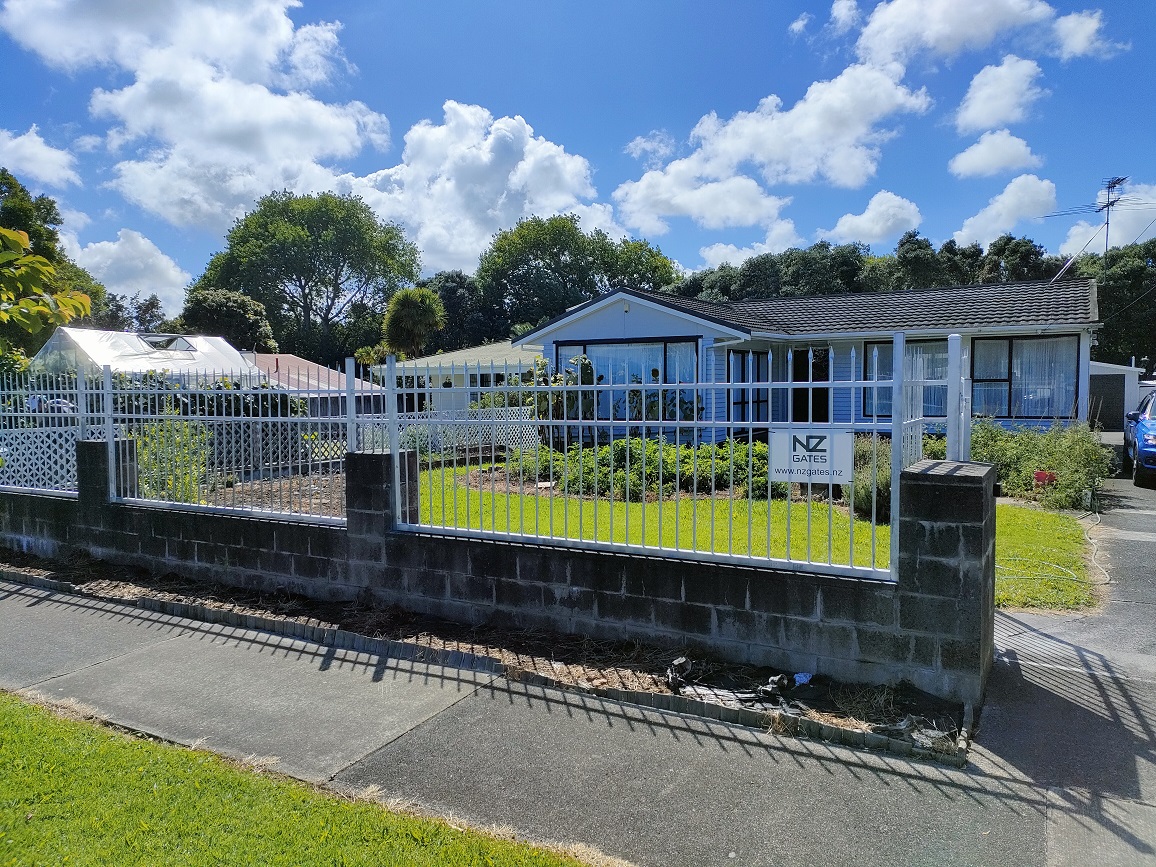
Perimeter fence integration is essential for total industrial yard security. NZ Gates fabricates matching industrial gates using heavy-gauge materials that resist cutting and climbing.
- 358 Anti-Climb 'Prison Mesh': Featuring a tight 76.2mm x 12.7mm aperture with 4mm high-tensile wire, this configuration prevents finger holds, resists bolt cutters, and provides unobstructed sightlines for security cameras.
- Heavy Steel Palisade: Pointed 'D' or 'W' profile vertical steel pales provide an imposing psychological and physical barrier against trespassers.
- Fully welded structural steel infill: Robust steel RHS or square balusters for industrial yards requiring maximum impact resistance against vehicle strikes.
Industrial Gate Automation: Motors, Duty Cycles and Power Resilience
The automated drive system is the heart of any commercial or industrial gate. Selecting an under-specified motor is the primary cause of industrial gate failures in New Zealand.
Understanding Continuous Duty Cycles
Residential and light commercial motors are rated with intermittent duty cycles, typically 30% to 50%, meaning they require cool-down periods between operations. If an intermittent motor is installed on an industrial gate cycling repeatedly, thermal overload cutouts will trigger, leaving your gate stuck open or closed during peak freight hours.
Industrial gate motors specified by NZ Gates feature 100% continuous-duty ratings. These motors utilize oil-bath lubrication, heavy-duty helical bronze gearboxes, and brushless DC or 3-phase AC technology to run continuously without thermal degradation.
Motor Power and Tonnage Capacity
Industrial steel gates can easily weigh between 1,000kg and 4,000kg, especially when fabricated to span 12 to 18 metres with security mesh or palisade infill.
- 400V Three-Phase Motors: Deliver massive starting torque and continuous power for extra-heavy industrial gates, ensuring reliable acceleration even during high Auckland wind storms.
- 24V and 36V Heavy-Duty Brushless Units: Provide pinpoint speed control, soft-start and soft-stop ramp profiles to prevent mechanical shock on gate leaves, and seamless integration with continuous battery backup systems.
- Variable Speed Frequency Inverters: Allow facility managers to customize opening and closing speeds, adjusting ramp-down deceleration to protect drive gears and structural posts from stress fatigue.
Power Outage Redundancy and Emergency Overrides
Auckland storm events, grid maintenance, or localized power outages must never paralyse your supply chain or leave your facility unsecured.
Industrial gate automation systems should incorporate heavy-duty uninterrupted power supplies (UPS) or solar-assisted battery banks capable of supporting dozens of full opening cycles during mains failure.
In addition, fast manual release mechanisms allow designated site security personnel to disengage the drive clutch with an ergonomic keyed lever, enabling smooth manual operation in seconds during an emergency or power cut.
Advanced Access Control Integration for Freight Yards
An industrial gate is only as effective as the access control ecosystem driving it. Managing the flow of staff, contractors, approved freight carriers, and unscheduled deliveries requires automated, multi-tiered credential management.
Automatic Number Plate Recognition (ANPR / LPR)
ANPR camera systems identify approved logistics vehicles on approach, verifying license plates against your site management database and triggering immediate gate opening without the driver rolling down their window. This eliminates bottlenecks and keeps delivery manifests running on time.
Long-Range UHF RFID Fleet Readers
For dedicated company fleets, contractors, and site vehicles, UHF transponder tags mounted inside windshields or on truck chassis allow automated hands-free detection from 6 to 12 metres away.
Heavy-Vehicle Ground Induction Loops
Induction loops cut into the concrete apron serve multiple functions:
- Safety detection: Prevents the gate from closing while a long trailer, truck chassis, or forklift is straddling the gate threshold.
- Directional free-exit triggering: Automatically opens the gate when an authorised vehicle approaches the exit zone from inside the compound, speeding up outbound logistics.
- High-chassis vehicle tuning: Calibrated specifically to detect high-clearance truck cabs, low-slung chassis, and trailers alike.
High-Mounted Truck Driver Intercoms
Traditional intercom pedestals are positioned for standard passenger cars. Industrial gates require dual-height intercom posts featuring audio-visual units at both car level (1.1m) and heavy truck cab height (1.8m to 2.2m). Integrated with 4G/5G cellular connectivity or IP networks, truck drivers can communicate directly with site dispatchers or remote control rooms from the cab.
Pedestrian Segregation and Turnstiles
A crucial safety principle under New Zealand workplace regulations is separating pedestrians from moving heavy machinery. Pedestrians must never walk through an automated industrial vehicular gate.
NZ Gates installs dedicated pedestrian side gates featuring magnetic locks, keypads, and self-closing hydraulic mechanisms, as well as full-height security turnstiles for high-volume worker shift changes.
WorkSafe New Zealand Compliance and Gate Safety Standards
Under the Health and Safety at Work Act 2015, automated gates are legally classified as plant and machinery. Persons Conducting a Business or Undertaking (PCBUs)—including property owners, employers, and facility managers—have an active legal duty of care to ensure moving gates do not present a hazard to staff, visitors, or contractors.
An automated industrial gate moving a 2,000kg steel leaf can exert crushing forces capable of causing catastrophic injury or death if safety systems fail. Compliance with AS/NZS machinery safety standards and WorkSafe guidelines is non-negotiable.
Mandatory Safety Features for Industrial Automated Gates
Every automated industrial gate engineered by NZ Gates integrates multiple overlapping fail-safe mechanisms:
- Dual-height monitored photoelectric safety beams: Infrared beams positioned across the entrance at 200mm (pedestrian/ankle height) and 800mm-1000mm (vehicle chassis height) that instantly halt and reverse gate travel if broken.
- Opto-electronic or resistive safety edges: Deformable rubber pressure strips installed along the leading gate edge, rear frame, and structural pinch zones. If the edge contacts any obstacle, it immediately disengages motor drive and reverses gate travel.
- Automatic force limitation: Advanced motor control boards constantly monitor torque and current draw, stopping within milliseconds if an abnormal obstruction is encountered.
- Audio-visual warning indicators: High-intensity amber strobe lights and pulsed audible sounders activate automatically 3 seconds prior to and throughout all gate movement, alerting pedestrians and forklift operators.
- Emergency stop controls: High-visibility mushroom emergency stop buttons installed inside and outside the perimeter for instantaneous manual shutdown.
- Physical guarding and entrapment protection: Mesh infills, post shielding, and safety screen guards that eliminate crush and shearing points around rolling wheels, drive pinions, and counterweight carriages.
Engineering for Auckland's Coastal Industrial Climate
Auckland's marine climate is notoriously aggressive towards external steelwork. Industrial zones in Onehunga, Penrose, Wiri, and Highbrook sit within kilometres of saltwater harbours, creating microclimates with accelerated corrosion rates.
To ensure your investment delivers a 20-to-30-year operational lifespan, NZ Gates adheres to rigorous protective engineering standards:
- Certified Hot-Dip Galvanising: All structural steel gate frames, posts, and tracks are fully fabricated and drilled before being immersed in molten zinc in accordance with AS/NZS 4680. This creates a multi-layered zinc-iron metallurgical alloy that permanently shields the steel from atmospheric moisture and salt.
- Architectural Powder Coating: For companies requiring specific corporate colours or a sleek architectural aesthetic, a premium architectural powder coat (Dulux Duratec or Interpon) is applied over the hot-dip galvanised base, providing double-barrier protection against UV fading and chemical fallout.
- Marine-Grade Stainless Steel Hardware: All fasteners, carriage bolts, hinge pins, and locking components use grade 304 or marine-grade 316 stainless steel to eliminate galvanic corrosion.
- IP66 Weatherproof Electronics Enclosures: Industrial control boards, loop detectors, and power modules are housed within hermetically sealed, IP66/IP67 rated enclosures with breather valves and internal heating strips to combat internal condensation and insect ingress.
Industrial Gate Preventative Maintenance Protocols
Because industrial gates operate under heavy daily cycle counts, preventative maintenance is essential to prevent costly operational downtime. A malfunctioning gate at a freight hub can trap dozens of delivery trucks, costing thousands of dollars in delayed logistics and supply chain penalties.
Furthermore, commercial insurers and WorkSafe New Zealand require documented evidence that automated machinery is regularly serviced and tested for safety compliance.
Quarterly Industrial Maintenance Checklist
- Safety device testing: Measure and log response times for photoelectric beams, safety edges, and force limitation sensors.
- Structural and mechanical inspection: Examine cantilever roller carriages, guide rollers, gate tracks, end stops, and welded joints for wear, cracking, or fatigue.
- Drive unit lubrication: Inspect gearbox oil levels, lubricate drive racks and pinions, and verify chain tension.
- Foundation and alignment check: Check post verticality and track levelness to detect any ground subsidence caused by heavy vehicle traffic.
- Electrical and control diagnostics: Tighten terminal connections, check backup batteries under load, and verify safety circuit integrity.
NZ Gates provides structured preventative maintenance agreements for industrial facilities across Auckland, with scheduled quarterly or bi-annual service visits, compliance certification, and priority 24/7 breakdown callouts.
Why Auckland Facilities Partner with NZ Gates
With over 30 years of specialized experience in the Auckland market, NZ Gates delivers comprehensive end-to-end industrial gate solutions.
We manage the entire project lifecycle in-house: from initial swept-path engineering assessments and Auckland Council building compliance, to precision structural steel fabrication in our local workshop, civil foundation installation, electrical automation, and ongoing preventative servicing.
Whether you need a massive 15-metre cantilever gate for a distribution centre, high-speed bi-fold gates for an urban depot, or a complete access control upgrade for a manufacturing facility, our team builds industrial gate solutions engineered for maximum security, safety, and longevity.
Contact the NZ Gates commercial team today on 021 022 75499 or request a free on-site consultation to discuss your facility's industrial gate requirements.